Platform
RapidAIM
A 96-well culture + metaproteomics platform to quantify how individual gut microbiomes respond to perturbations, with biomass, taxonomic biomass, and functional readouts in one workflow.
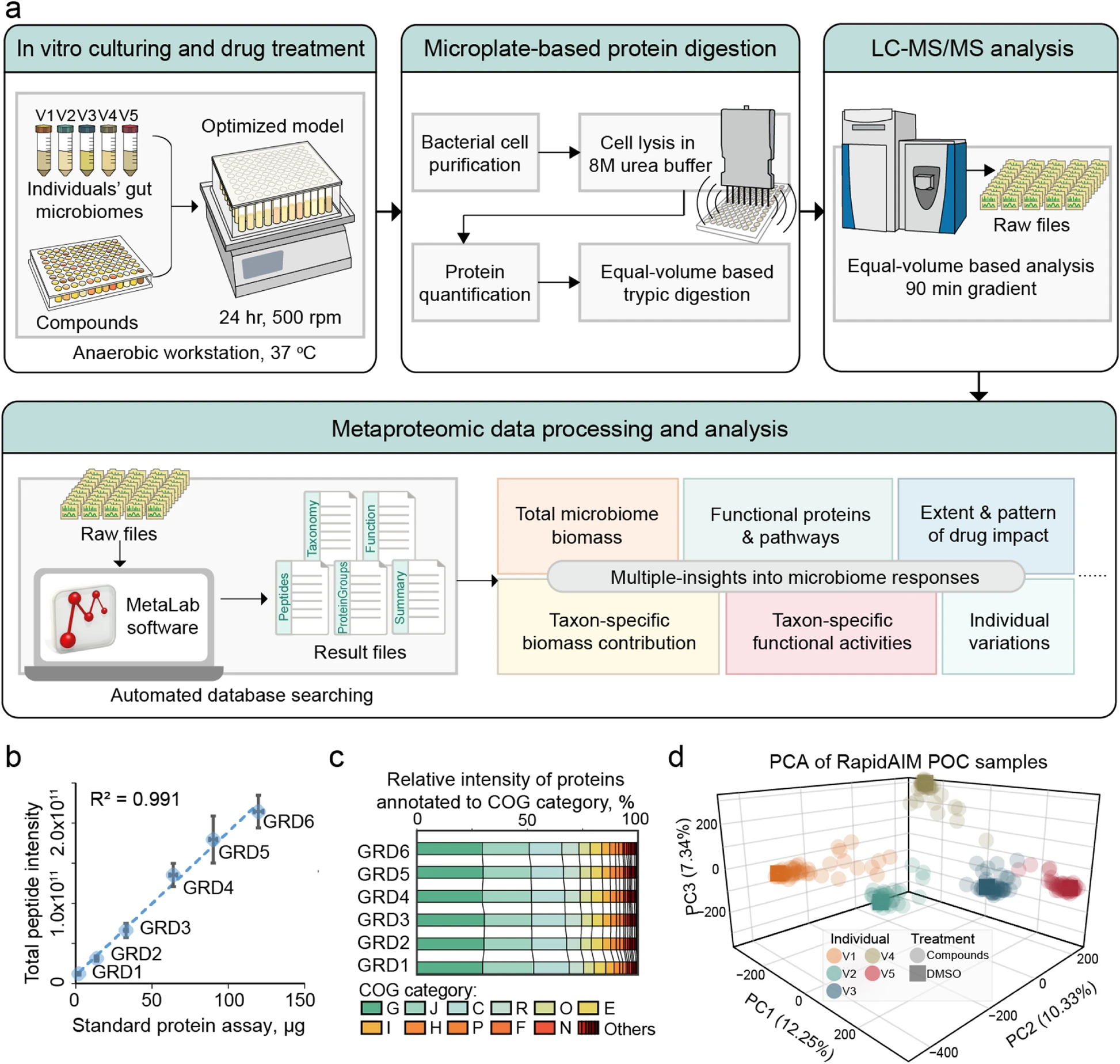
Figure sources:
- Li, L., Ning, Z., Zhang, X. et al. RapidAIM: a culture- and metaproteomics-based Rapid Assay of Individual Microbiome responses to drugs. Microbiome 8, 33 (2020). https://doi.org/10.1186/s40168-020-00806-z
- Li L, Mayne J, Beltran A, Zhang X, Ning Z, Figeys D. RapidAIM 2.0: a high-throughput assay to study functional response of human gut microbiome to xenobiotics. Microbiome Res Rep. 2024;3:26. http://dx.doi.org/10.20517/mrr.2023.57
Please ensure reuse complies with publisher copyright and license terms.
What RapidAIM does
- Runs ex vivo gut microbiome culture in a standardized 96-well deep-well format under strict anaerobic conditions
- Uses microplate metaproteomics sample preparation (cell washing → lysis → digestion → desalting) for scalable processing
- Quantifies total microbiome biomass using an equal-volume strategy with summed peptide intensity as a proxy
- Reports taxon-specific biomass contributions and functional pathway responses from the same LC-MS/MS measurement
- Supports automation and multiplexing upgrades (RapidAIM 2.0: automated prep + TMT11plex) for large screening matrices
Workflow
Method steps
A. Culture + treatment
96-well deep-well anaerobic culturing of individual microbiomes with defined perturbations.
B. Cell washing
Plate-format centrifugation and PBS washes; pellet can be frozen as a pause point.
C. Protein extraction + purification
Plate-compatible lysis (e.g., ultrasonication) followed by purification (e.g., precipitation-based cleanup).
D. Digestion + desalting
Protein quantification → standardized dilution → (optionally automated) digestion and desalting.
E. TMT labeling (RapidAIM 2.0)
TMT11plex labeling in 96-well plates; pooling + cleanup for multiplexed LC-MS/MS.
F. LC-MS/MS + analysis
LC-MS/MS → metaproteomics search + quantification → normalization and functional interpretation.